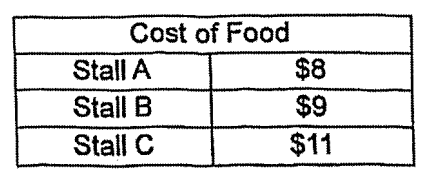
Mr Abdul received some Majulah Singapura vouchers in denominations of $2, $5 and $10. There were as many $10 vouchers as $5 vouchers. The ratio of the number of $2 vouchers to the number of $10 vouchers was 3: 2. The value of all the vouchers was $1260. After a month, Mr Abdul had 4 $2 vouchers, 2 $5 vouchers and 1 $10 voucher left. He bought some food from 3 different stalls. Payment was made at each stall using vouchers, cash or a combination of both. The value of the vouchers used at each stall cannot be more than the cost of the food. What was the least amount he could have paid in cash? (2 marks)
Answer: $ 2
Workings
Loading drawing…
Loading drawing…
left
→ 4 x $2 voucher + 2 x $5 voucher + 1 x $10 voucher
we need to buy food from each stall, without using as much cash as possible
e.g Stall A if used one $2 voucher, we need to use $6 cash
$8 (food) - $2 (voucher) = $6 (cash)
better to use 4 x $2 voucher
$8 (food) - 4 x $2 (voucher) = $0 (cash)
This is better cos we don't use cash
Let's start at Stall C
Stall C
→ $11 (food) - 1 x $10 (voucher) = $1 (cash)
Stall B
→ $9 (food) - 1 x $5 + 2 x $2 (vouchers)
= $0 (cash)
Stall A
→ $8 (food) - 1 x $5 + 1 x $2 (vouchers) = $1 (cash)
Total cash
→ $1 + $1 = $2
Video explanations
1 video